Four Questions to Ask Before You Buy Into a Floor Business
October 17, 2026 · FloorIt Insights
Watch the video on this page. It runs about 9 minutes and takes the four questions in order. Open the video page
Before you buy into any floor business, ask four questions: is it a franchise, is it too good to be true, how does the company make money, and what is the catch. Any business offer worth your time should answer all four clearly, in writing, before you sign. In this video, Alex, the owner of FloorIt, answers each one about FloorIt. This post walks through his answers, adds the fees and territory rules worth checking in any offer, and ends with a short list you can take to any call.
The four questions
These are the questions FloorIt hears on almost every call. They are the right ones to ask, of FloorIt or of anyone else selling you a business.
Each one gets at the same thing from a different side: where your money goes, and what the company gains when you do well or badly. If a company gets vague on any of the four, slow down.
- Is this a franchise?
- Is it too good to be true?
- How does the company actually make money?
- What is the catch?
Question 1: is it a franchise?
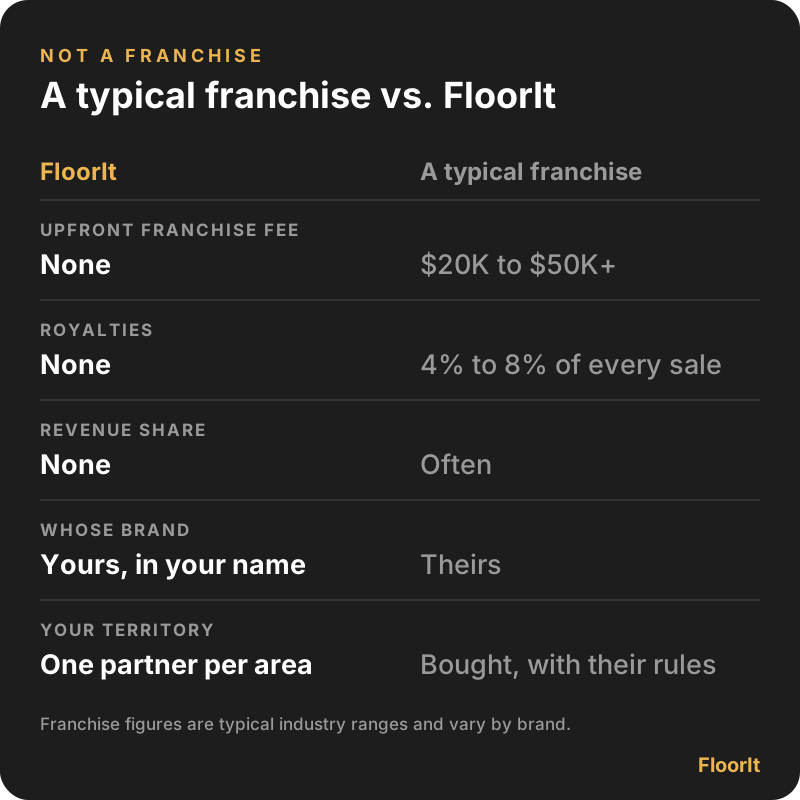
FloorIt is not a franchise. To see why that matters, look at how a typical floor franchise makes money. First, a big fee up front, just for the right to use the brand.
Then a royalty: a share of every job you do, usually around 4% to 7% of the revenue, for as long as you own the business. There is no cut-off. Many franchises also take a percentage of your yearly revenue for a national brand ad fund, which means part of your money goes to advertising their name, not yours. And some require a minimum amount of local ad spend every month on top of all that.
Alex says it seems lucrative going in, but a lot of revenue and profit ends up flowing back to the franchise. He has spoken with plenty of franchise owners who want out, because the fees and the ad fund cost more than they make.
What two floor franchises list in their disclosures
The video uses two floor care franchises as examples, with figures taken from their own franchise disclosure documents. Mr. Sandless lists a total investment of about $35,000 to $90,000 depending on the area, a 6% royalty with a $600 monthly minimum, a national ad fund of 1% to 4%, and at least $1,500 a month in local ads. N-Hance lists about $64,000 to $90,000 for the license and package, plus a 6% royalty.
Notice what the minimums do. A royalty minimum and a local ad minimum are owed whether or not you have customers yet, so those costs start before your first job. Alex is clear he is not attacking anyone, and that these figures change, so always read the latest disclosure yourself.
If you are weighing any franchise, these are the parts of the disclosure document worth reading slowly:
- Item 5 and Item 6: the initial fee and every ongoing fee, including royalties, ad fund and minimums.
- Item 7: the estimated total investment to open, not just the franchise fee.
- Item 12: the territory, how it is drawn and what protection you actually get.
- Item 19: any figures the franchise gives about what owners earn, and how they were measured.
- Item 20: how many owners joined and left, with contacts you can call and ask.
The territory question behind the franchise question
Territory is where many offers quietly limit you. Alex says franchises usually drop a pin and hand you a set population, often around 250,000 to 450,000 people. Growing past it means buying more.
FloorIt starts you with a 30-mile radius around your center point, with the zip codes inside it listed in your agreement. Thirty miles is about as far as most people will drive to give an estimate. While you are active and keeping up your side of the agreement, FloorIt will not sign another partner for your territory or run FloorIt-funded ads for anyone else there. You can still take jobs anywhere, and other floor companies can still work in your area.
Growing it costs nothing. You send FloorIt a written proposal for the area you want, you meet to confirm nobody else holds it and that you can serve it, and if both are true it is added in a signed addendum. The video gives the common case: you hire an estimator who lives further out and want to cover their area too. Alex says the incentive is to give you as much area as you can handle, because the more you grow, the more FloorIt grows.
Question 2: is it too good to be true?
Alex says he would rather you check than trust him. The company behind FloorIt has been registered since 2022. It used to be called Prestige Performance, and its Google reviews still show that earlier name.
Before floors, it ran marketing for home service businesses: martial arts schools at the very start, then heating and air, plumbing, flooring and roofing. That work has generated more than $12 million for home service businesses over more than three years.
Here is how to check any company, FloorIt included. Search the business by its legal name and any earlier names. Read the reviews and look at when they were left. Read the website and see exactly what gets built for you. Then ask your hardest questions on the call and see whether the answers match what is written down. A real offer holds up when you check it.
Question 3: how does FloorIt make money?
FloorIt gets paid two ways. There is the one-time partner package, which covers the business it builds, the equipment, the training and your first 50 leads. And there is the finish you reorder. There is no charge for leads after your first 50: they come bundled in when you reorder finish. You can also run your own marketing with the ad library and training you keep for life.
The long-term money is the finish. Every job uses finish. The package includes 12 gallons, so you do not start by ordering, and a 1,000 sq ft job uses about 1.8 gallons. When you use it up, you reorder, and that is where FloorIt profits. You only reorder when you are doing jobs, so FloorIt does best when your calendar is full.
That is also why Alex says he does not want to bring on people who will not push to grow their area. A partner who does few jobs uses little finish. A partner who keeps pushing uses more, and both sides do better.
Alex is honest about one more thing. Not every job will use FloorIt finish. Some floors need a different finish or different materials, and the flooring company FloorIt partners with helps you choose. There is no minimum order and no obligation to buy finish from FloorIt at all.
Question 4: what is the catch?
The honest answer is the one-time investment. FloorIt covers the exact amount on your call, and you see the full amount before you sign anything. After that, there is no royalty, no ad fund, no territory fee and no ongoing fee. Your business carries your own name, and you own it.
The other honest part is what the package does not cover. Know these before you sign:
- Any ads you choose to run yourself, on top of the leads that come bundled with finish reorders.
- Buffer rentals after your first 3.
- Finish after your first 12 gallons.
- Your own costs of doing business, like insurance and any license your area requires.
Why the answers matter, and a list to take to any call
Where the money flows tells you what a company will spend its time on. A company paid up front, with a royalty no matter how your month went, does not need you to be busy. A company paid when you reorder finish only does well if you do. Alex sums it up: a typical franchise gets paid when you buy in and takes a cut of every job. FloorIt gets paid when you reorder finish, which only happens when you stay busy.
Whatever you choose, get clear answers to these before you sign:
- Every fee, written down: up front, monthly, per job, ad fund, ad minimums and territory fees.
- How the company is paid after you start, and whether it earns when you are slow.
- The size of your territory, what protection it gives, and what it costs to grow it.
- What is not included, so you can budget for it.
- What happens if you want out, and whether there is any refund.
- Who is behind the company, and how you can check them.
Common questions
- Is FloorIt a franchise?
- No. There is a one-time investment, then no royalties, no ad fund, no territory fees and no ongoing fees. The business is built in your name and you own it.
- Do I have to buy finish from FloorIt?
- No. There is no minimum order and no obligation to reorder. If you do reorder, that is where FloorIt makes its long-term money.
- How big is a FloorIt territory?
- It starts as a 30-mile radius around your center point, exclusive while you are active and meeting your side of the agreement. You can expand it at no cost if nobody else holds the area and you can serve it.
- Is there a refund if it is not for me?
- Yes, through the 30-Day Action-Taker Guarantee. If you put in the work in your first 30 days and still decide FloorIt isn't for you, you are refunded what you paid, minus what FloorIt has already delivered or spent for you.
- Can I leave whenever I want?
- Yes. There is no lock-in and no minimum term. You can end the agreement any time with written notice, and you keep your brand, your customers and lifetime access to the resources.
Ready to bring the recoat to your city?
One partner per area. Check if yours is open.
More Insights
How Many Homes Have Hardwood Floors? What It Means for a Recoat Business
October 17, 2026
A Home Service Business That Stays Busy in Winter: 5 Years of Data
October 17, 2026
Hardwood Floor Demand Calculator: How to Read Your Area's Report
October 17, 2026
An Add-On Service for Home Service Companies: Why Owners Add Recoats
October 17, 2026
How to Recoat Hardwood Floors, Step by Step: All 7 Stages of a Job
October 17, 2026
Facebook Ads for Flooring: Cost per Lead, per Estimate and per Job
October 17, 2026