
The finish
What goes on the floor
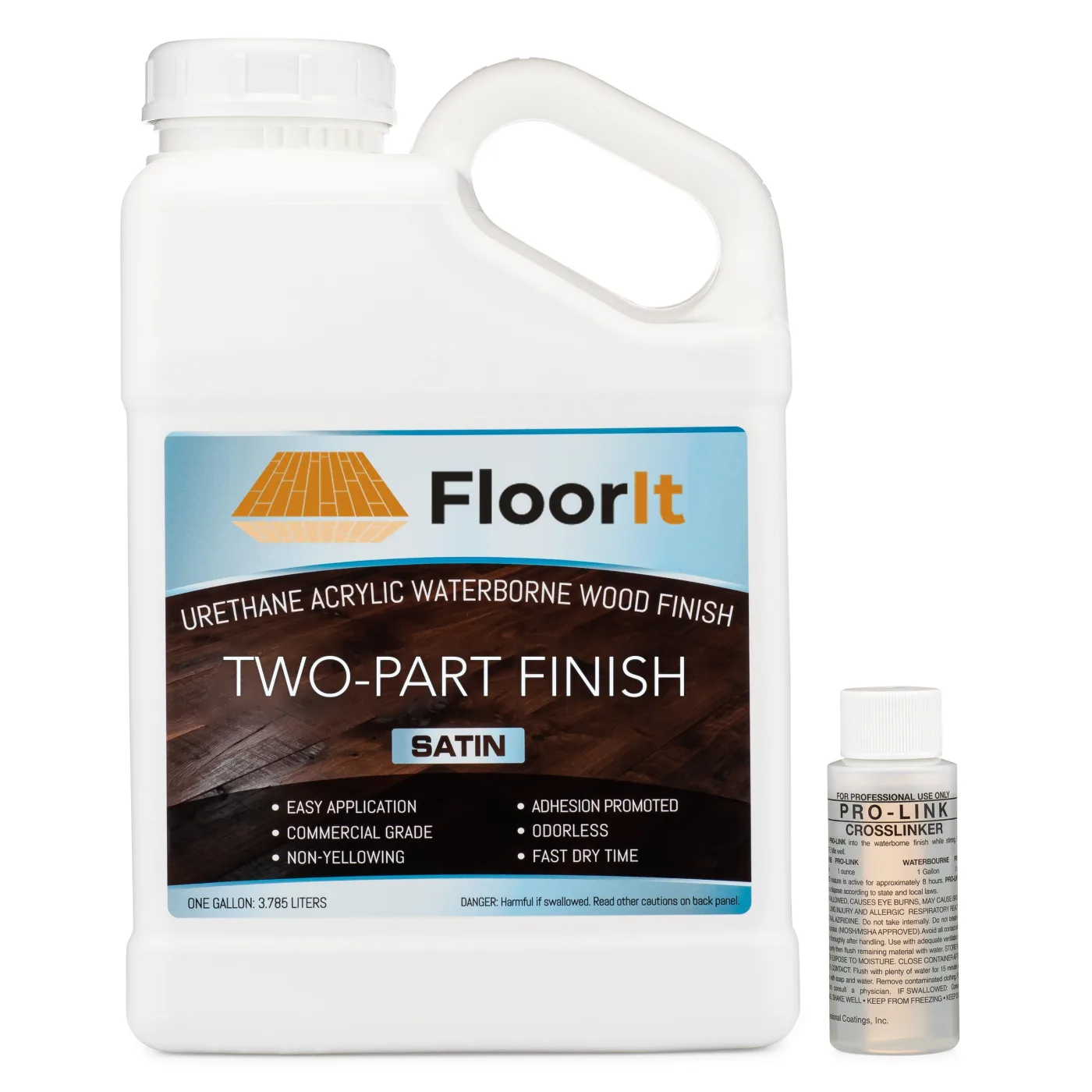
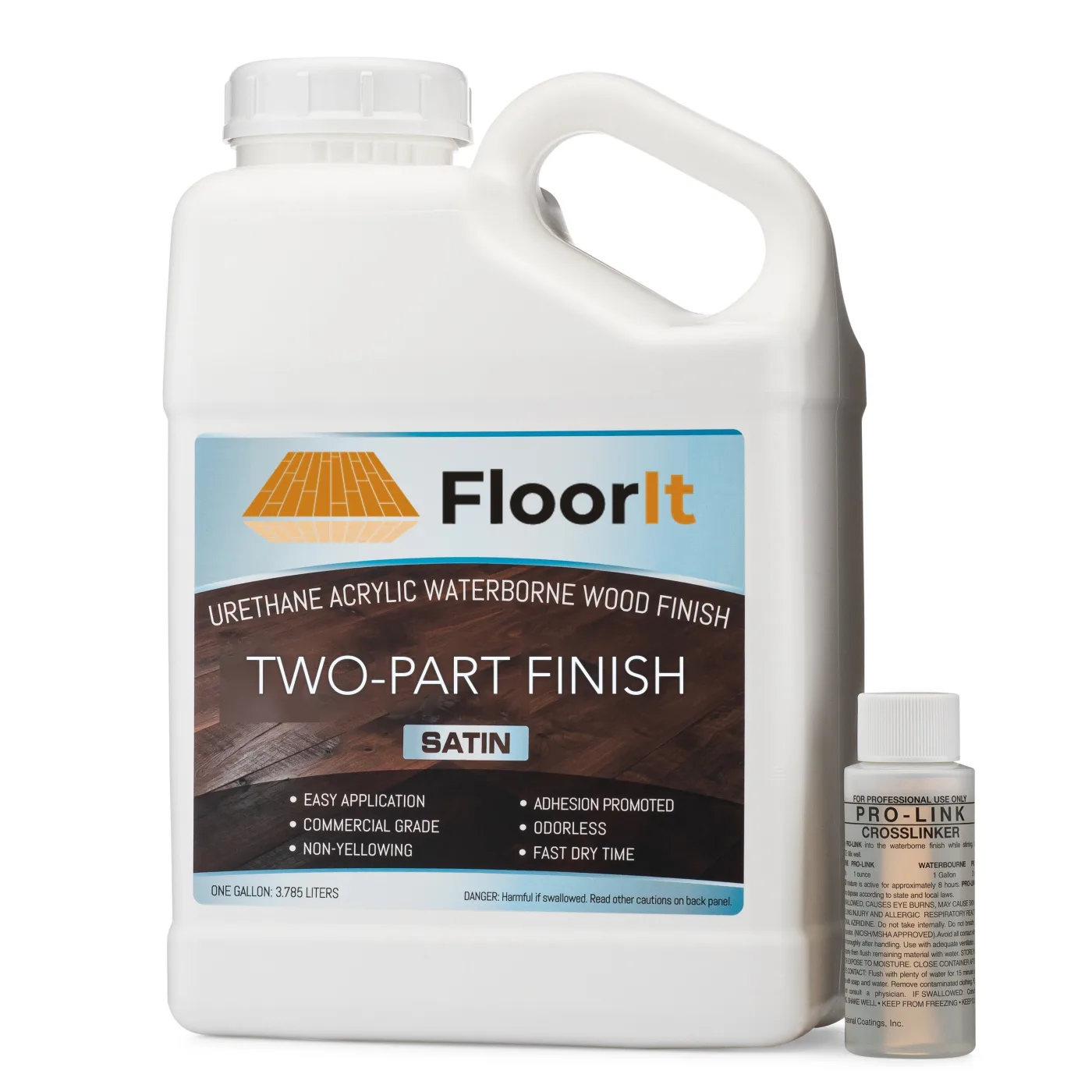
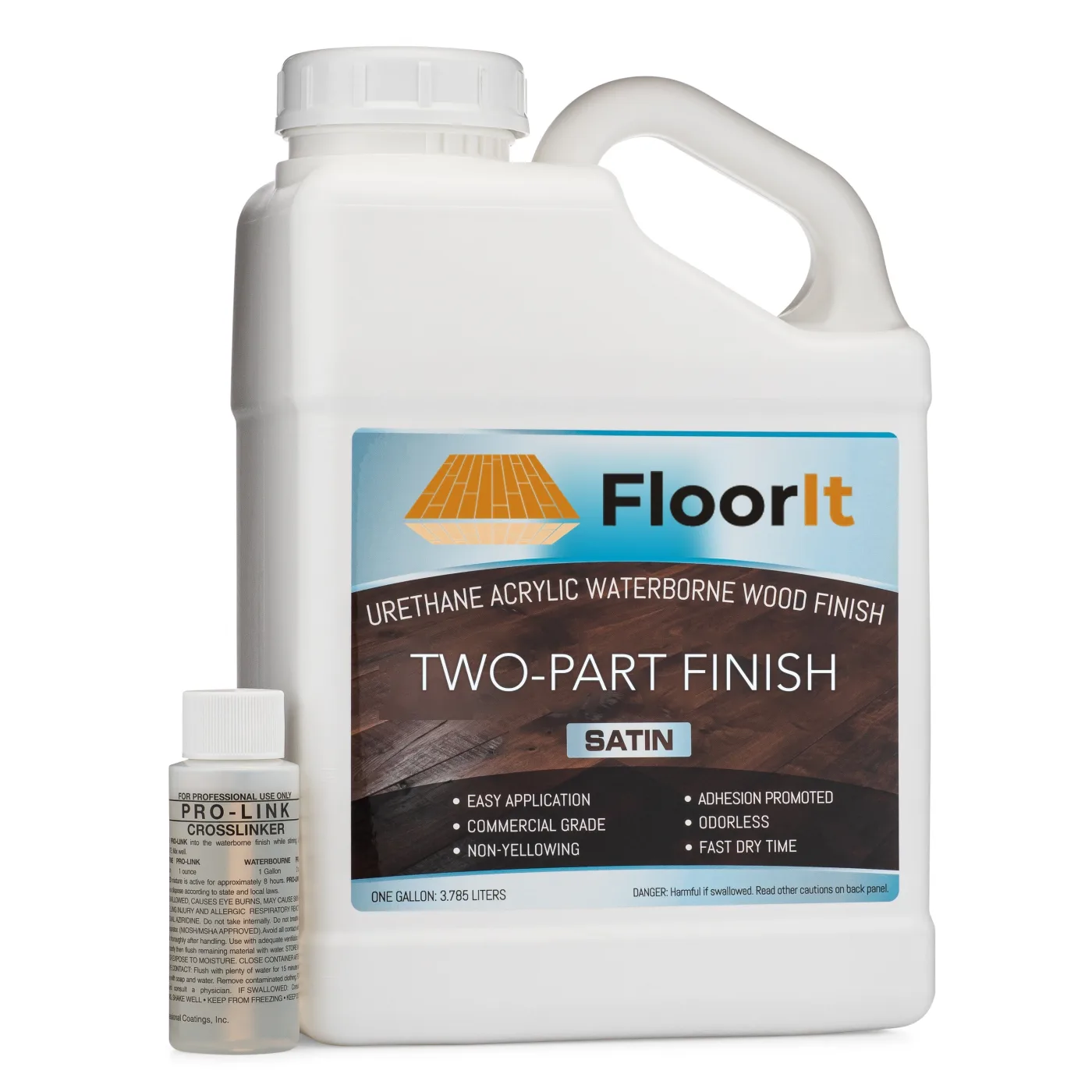
FloorIt Two-Part Finish: a water-based urethane, a proprietary mix manufactured by ProCoat in Cabot, Arkansas, 100% made in the USA. It's the same product on every job, built around the exact process we train you on.
- Cures hard, chemically, and bonds to the old finish
- Stays clear: it won't turn yellow
- Rated for homes, commercial and sport floors
What it is
Two parts, mixed on the job
Part A: the finish
A urethane acrylic resin carried in water. About a third of the gallon is solids, the part that stays on the floor.
Part B: the crosslinker
The small bottle. You pour it into the gallon on the job and shake it. It ties the resin together as it cures, into a hard, tough coat.
Not epoxy, which is for garage floors and concrete. Not a wax or a polish, which sit on top and wear off. A real floor finish that becomes part of the floor.
By the numbers
Tough, and the data sheet shows it
45 mg
lost in a 1,000-cycle Taber abrasion test
They grind a coated panel under weighted wheels for 1,000 turns and weigh what came off. Less is tougher.
90
Koenig hardness
How hard the cured coat is. That is what keeps scratches and dents out of the finish.
0.87
static coefficient of friction
Grippy underfoot, not slick. It matters in homes with dogs, kids and older parents.
< 250
grams per liter of VOC
Water-based, with a mild smell and water clean-up.
Source: the manufacturer's technical data sheet.
Full specifications
Everything on the data sheet
| Type | Two-part, water-based acrylic urethane wood finish |
|---|---|
| Made in | Cabot, Arkansas, USA. A proprietary mix manufactured by ProCoat |
| Sheen | Five sheens: gloss, semi-gloss, satin (the default, 25 gloss units), matte and ultra matte |
| Color | Goes on white, dries clear. Non-yellowing |
| Solids | 33% (plus or minus 2%) |
| VOC | Under 250 grams per liter |
| Abrasion | 45 mg lost, Taber test, CS-17 wheels, 1,000 g load, 1,000 cycles |
| Hardness | Koenig 90 |
| Traction | 0.87 static coefficient of friction |
| Wear rating | Commercial grade, rated for residential, commercial and sport floors |
| Coverage | 500 to 600 sq ft a gallon. An average 1,000 sq ft floor takes about 1.8 gallons a coat |
| Mix ratio | 1 ounce of crosslinker to 1 gallon of finish (product label) |
| Once mixed | Usable for about 8 hours (product label). Mix only what the job needs |
| Recoat | 2 to 4 hours between coats |
| Light use | 24 hours |
| Full cure | 7 days |
| Dry times measured at | 65 to 80 °F and 40 to 60% humidity. Cooler or damper rooms take longer |
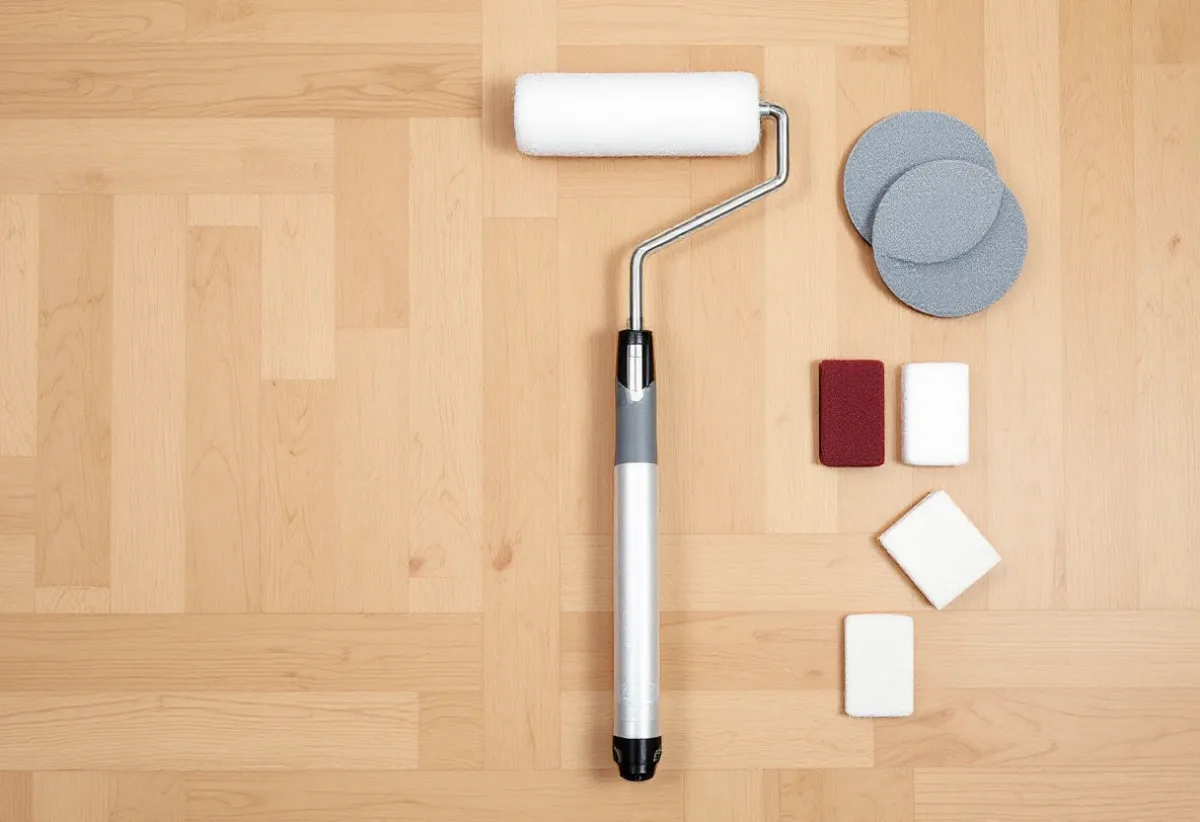
| Applied with | A 3/8" or 1/4" microfiber roller on an extension pole, and a trim pad for the edges |
| Clean-up | Water |
| Smell | Mild. No solvent fumes |
| Weight | About 8.6 lb a gallon |
| Flash point | Above 200 °F |
| Pack | One-gallon jugs, 4 to a case |
| Shelf life | 1 year from production, unopened |
| Storage | Keep between 50 and 90 °F. Never let it freeze, never above 95 °F |
| Shipping | Not regulated as hazardous for ground shipping (DOT). Ships like normal freight |
Sources: the technical data sheet, the safety data sheets for both parts, and the product label. Partners get the full data sheets in training.
Why not the store?
The store sells a different product
| Question | Store polish | One-part poly | Oil-based poly | FloorIt two-part |
|---|---|---|---|---|
| What it is | An acrylic film on top | Poly with no hardener | Solvent-based poly | Urethane plus a crosslinker |
| Does it cure hard? | Never really cures | Stays softer | Yes, slowly | Yes, chemically |
| Bonds to the floor? | No, it peels | Barely | Yes | Yes, to the screened finish |
| Color over time | Clouds and scuffs | Can amber | Turns yellow-orange | Stays clear, won't yellow |
| Smell | Mild | Mild | Strong solvent fumes | Mild, water clean-up |
| Second coat | Not built for it | Varies | Usually the next day | Same day, 2 to 4 hours |
| Over time | Has to be stripped | Chips and blotches | Durable, but ambers | 20+ years on a maintained floor, per the manufacturer |
Two-part finishes mostly go through flooring suppliers to contractors, not the paint aisle. And the gallon is the easy part: knowing how to test, screen and read each floor doesn't come in a can.
Why it's better
What it does that the alternatives don't
Harder than a one-part
A one-part finish just dries. Ours has a crosslinker that chemically locks the resin into a network as it cures, which is where the Koenig 90 hardness and the 45 mg abrasion result come from.
Clearer than oil
Oil-based poly turns floors yellow-orange over the years and fills the house with solvent fumes. This stays clear, smells mild and cleans up with water.
Faster than oil
Oil often means one coat a day. This takes a second coat 2 to 4 hours later, so most floors are done the same day and the family never moves out.
Safer underfoot
A 0.87 static coefficient of friction, well above the 0.5 commonly used as the bar for a slip-resistant floor. That matters with dogs, kids and older parents.
Goes further
500 to 600 square feet a gallon, so an average floor takes about 2 gallons a coat.
Built for heavy use
Rated commercial grade, for homes, businesses and sport floors, so a busy family kitchen is well within what it's made for.
Different, so you don't compete on price
A lot of floor guys carry the same big-brand jug, so every quote is the same product and the homeowner just picks the cheapest. FloorIt partners show up with a finish that locks and bonds, grips better and goes on LVP too. You don't have to be the cheapest quote, because the homeowner isn't comparing the same thing. Charge for the better floor.
How it goes down
A roller and a pole, about 3 hours
Step 1
Clean and test
Deep clean the floor and test for wax or store polish. If it is there, it comes off first.
Step 2
Screen
Run the buffer with a screen until the whole floor is evenly dull, so the new coat can grip.
Step 3
Vacuum and tack
Vacuum everything, baseboards too, then tack the floor so no dust is left.
Step 4
Mix
Pour the crosslinker into the gallon, shake 30 to 45 seconds and let it rest 10 to 15 minutes.
Step 5
Cut in and roll
Trim pad along the walls, then roll the open floor with the grain, working toward the door.
Step 6
Second coat if needed
Ready for another coat in 2 to 4 hours. Same day.
One person can do an average floor in about 3 hours. A gallon covers 500 to 600 square feet; don't stretch it thinner than that. Wear gloves and eye protection when you mix.
For the homeowner
The family stays home
2 to 4 hours
Ready for a second coat
24 hours
Light use, socks on
About 3 days
Furniture back, on felt pads
About 7 days
Fully cured, rugs back down
On regularly maintained floors, the manufacturer puts it at 20+ years. Partners put every customer on a yearly maintenance plan, and rugs on the busiest walkways, felt pads under furniture and the right cleaner keep the wood underneath protected.
Which floors
Built for real wood, and LVP too
A good fit
- Solid hardwood
- Engineered wood
- Factory-prefinished floors
- LVP (one coat, test a spot first)
- Homes, commercial and sport floors
Needs more than a recoat, or not a fit
- Deep gouges or stains soaked into the wood
- Floors worn down to bare gray wood
- Laminate, sheet vinyl, tile, painted floors or epoxy
Not sure about a floor? Partners send photos to our flooring partner and get told the product and the steps. On vinyl plank (LVP): a light scuff with a fine maroon pad, one coat, and test a spot first. Ultra matte matches most LVP.
Safety
A professional product, handled like one
The finish (Part A)
Labeled WARNING: it can seriously irritate eyes. Wear gloves and safety glasses. With good airflow, a respirator is not normally needed.
The crosslinker (Part B)
Labeled DANGER: it can cause serious eye damage and skin allergies, and its safety data sheet lists further hazards. Wear butyl rubber gloves and goggles when you mix, and don't breathe the vapor.
On the job
Windows open and fans pulling air out of the room. Keep the family out of the room while it goes on and dries. Leftover mixed finish never goes down a drain: let it harden in an open container outside, then throw it out as a solid.
It's labeled for professional use. Partners get both safety data sheets and the full safety steps in training before their first job.
Questions
What people ask about the finish
How many coats does a floor need?
One or two. One coat does about half of jobs, and worn traffic lanes get a second. Coats go on 2 to 4 hours apart.
Do I sand between coats?
Not if the next coat goes on within 24 hours. After that, or for the smoothest result, lightly abrade with 180 to 240 grit first.
What has to happen before it goes on?
The floor has to be free of wax, polish and oily residue, then screened, vacuumed and tacked. Skipping the test for wax and polish is how a coat fails to stick.
Does it smell?
Mildly. It is water-based, so there are no solvent fumes like an oil finish. Keep the room ventilated while it dries.
Is it epoxy?
No. Epoxy is for garage floors and concrete. This is a wood floor finish.
Can it go on LVP or cork?
Yes on LVP: a light scuff with a fine maroon pad, then one coat, and test a spot first. It fuses to the factory wear layer, and ultra matte matches most LVP. Cork is on the data sheet too, so test a spot before you take that job.
How long does it last?
On regularly maintained floors, the manufacturer puts it at 20+ years. How long depends on traffic and care: rugs on the busiest walkways, felt pads under furniture, a neutral wood cleaner, and never store shine, oil soap or a steam mop.
Where do partners get more?
They reorder from us and it ships to their door. There is no minimum order and no obligation to buy from us.
The finish and the kit ship to your door
Partners start with the finish, the roller kit and their first buffer rentals covered, then reorder finish from us when they run low.
One partner per area. Check if yours is open.