
What each one is
A hardwood floor has two parts: the wood, and the clear finish on top that protects it. Day to day, it's the finish that takes the wear. Shoes, pets and furniture leave it dull, scratched and worn in the traffic lanes. The NWFA's homeowner handbook says most scratches happen in the finish, not in the wood itself.
A screen and recoat lightly buffs the old finish so a new coat can grip, then rolls on a fresh coat. It doesn't sand into the wood. A sand and refinish grinds off all the old finish and a thin layer of wood, then stains and coats the bare floor from scratch. Replacing means tearing out the old boards and putting in a new floor.
Think of a car. A recoat is like putting a fresh clear coat on a car whose paint is still good. A full refinish is like stripping the car down to bare metal and painting it again. Replacing is buying a new car. If the paint is fine, there's no reason to strip it. The same goes for your floor.
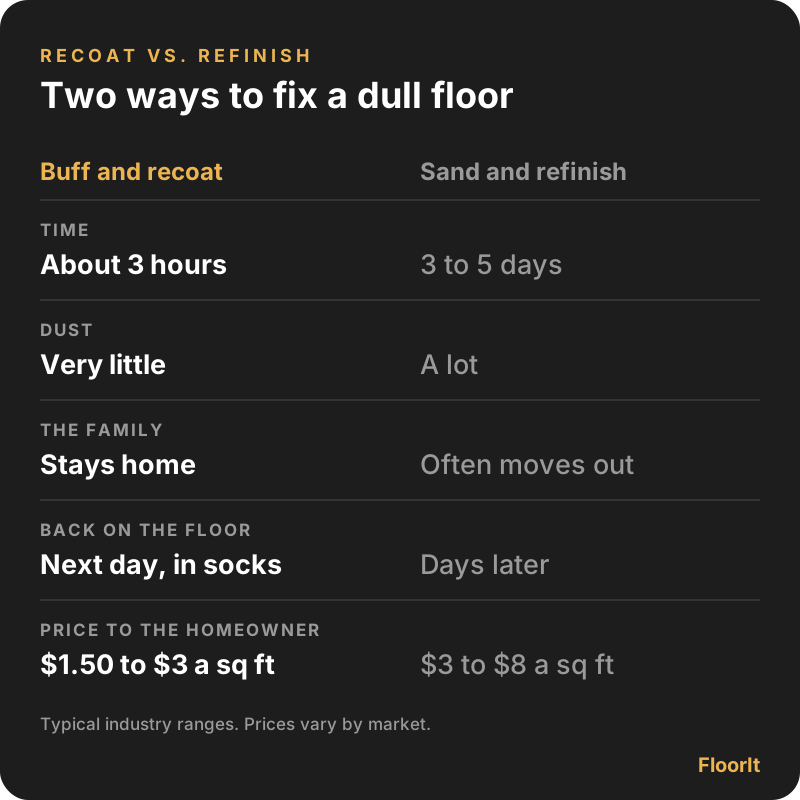
What each one costs
| Option | Per square foot | For a 1,150 sq ft floor |
|---|---|---|
| Recoat | $1.50 to $3 | $1,725 to $3,450 |
| Sand and refinish | $3 to $8 | $3,450 to $9,200 |
| Replace with new solid hardwood | $6 to $25, plus $1 to $4.47 to tear out the old floor | $6,900 to $28,750, plus $1,150 to $5,141 to tear out |
The recoat price is what homeowners commonly pay for a recoat. The sand and replace prices are the published national ranges from the cost guides at Bob Vila, Fixr, This Old House and NerdWallet, updated between 2024 and 2026. The tear-out cost is $1 to $3 a square foot from Fixr and NerdWallet, and $2.42 to $4.47 from the Homewyse estimator (May 2026). The floor size, 1,150 square feet, is the size FloorIt uses for an average floor. Each total is the price per square foot times 1,150.
Every price here is a range, so we show the low and the high side by side. Stain adds $1 to $3 a square foot to a sand job (Bob Vila, Fixr, This Old House). Every company sets its own price.
How long each one takes
| Recoat | Sand and refinish | Replace | |
|---|---|---|---|
| On the job | About 3 hours, one person, on an average floor (FloorIt standard) | 3 to 5 days (This Old House), up to 7 days or longer if it is complicated (NerdWallet) | Under 3 days to install a floor under 1,500 sq ft (Fixr), after the tear-out |
| Before the work | Nothing | Nothing | New boards sit in the house 1 to 2 weeks to adjust (This Old House) |
| Dust | Some fine dust from screening, vacuumed and tacked up | "No refinishing process is entirely dust-free" (Bob Vila). Dustless systems make less, not none (Fixr) | From tearing out the old floor |
| Staying home | Yes. Stay out of the room while it dries | For most or all rooms, Fixr says to think about staying somewhere else | You may have to avoid a room or area (NWFA) |
After a recoat, the family can walk on the floor in socks after 24 hours, put furniture back in about 3 days, and put rugs down in about 7 days, when the finish is fully cured. Those times are FloorIt's standard for its finish. The NWFA says rugs should usually stay off any new finish for at least seven days.
No outside source publishes how long a recoat job takes, so the 3 hours is our own standard. No source gives a total time for a replacement from start to finish either.
How much wood each one uses up
6 to 8
Sandings in the life of most solid wood floors (NWFA)
Up to 1/16"
Of wood a sand job can take off each time (NWFA)
Under 3/32"
Too thin to sand, for engineered floors (NWFA)
A wood floor only has so much wood to sand. Brett Miller, the NWFA's head of technical standards, wrote in 2025 that most solid wood floors can be sanded six to eight times in their life, and a traditional sand job removes 1/32 to 1/16 of an inch each time.
Engineered floors have less. Their top layer of real wood runs from 1/16 to 1/4 of an inch, and where it is under 3/32 of an inch, the NWFA does not recommend sanding at all.
A recoat screens the old finish "without cutting into the wood" (Fixr). So every time a floor gets a recoat instead of a sand, it keeps the wood it has. No source says how many sandings regular recoats save, so we won't put a number on it.
What the NWFA recommends
The NWFA is the trade group for the wood flooring industry. It recommends having a wood flooring professional put a new coat of finish on floors from time to time, depending on use and lifestyle. It recommends a full sand and refinish every few decades, or when there are deep scratches, dents or other damage, or the finish has worn away and bare wood shows (NWFA, 2019). Recoat on time and the wood underneath stays protected, so the floor can go decades before it ever needs that full sand.
So the industry's own advice is the recoat. Homes with kids and pets often need it more often.
To keep wood floors looking and performing well for generations, periodic recoating of your floors is all that's necessary.
When a recoat is the right call
- The floor looks dull or cloudy
- There are light surface scratches in the finish
- Traffic lanes look worn but the wood is not showing
- You like the color and just want it to look new
- You want it done in an afternoon and can't move out
Recoating on time also protects the wood, so the floor may not need a full sand for years.
If the wood is fine and only the finish is tired, a recoat is usually the right call.
Wait too long and a recoat is off the table
- Dull or scratched finish: a recoat, about $1.50 to $3 a square foot
- Finish worn through to bare wood: a full sand, about $3 to $8 a square foot
- Damaged, or too thin to sand again: replace, about $6 to $25 a square foot
A recoat needs finish to bond to. The NWFA's professional guide says: "If the finish is worn to the point that the color of the wood is not uniform or that bare wood is exposed, complete resanding and finishing is necessary" (NWFA C100, 2010).
No one publishes how fast a floor moves from one step to the next. It depends on the home. The cheapest time to act is while there is still finish to coat.
When you need a full sand and refinish
- Scratches or gouges that go through the finish into the wood
- Bare spots where the finish is worn all the way through
- Dents. The NWFA says these usually need new boards
- Cupped or warped boards
- Color change from light, like the pale square where a rug sat for years
- Pet or water stains in the wood. The NWFA says pet stains may not come out even after a full sand
- You want a different color
- The floor has wax on it, or years of polish from store products
A good recoat company will tell you up front if your floor is one of these. If they don't check, ask them to. Not sure which one you have? Send a few clear photos in good light, and a good company can usually tell you which job your floor needs.
Two more things to know. Recoating a factory finish may void the floor's warranty, so check yours first (NWFA). And a recoat works on solid hardwood, engineered and factory-prefinished floors, and on luxury vinyl plank (LVP), with a light scuff and one coat. Test a spot first. It is not for laminate, tile, sheet vinyl or painted floors.
What homeowners think about wood floors
52%
Of homeowners say they have wood floors
66%
Would choose wood for their dream home
79%
Say wood adds the most value to a home
Those figures are from a national survey of 1,001 homeowners for the NWFA in 2017. People love the floor. Their top worry was not the price. It was scratches and wear from kids and pets. The survey did not put a percentage on that worry.
What to ask a recoat company
- What finish do you use? A two-part finish, with a hardener mixed in, is tougher than store polish or one-part poly
- How do you check the floor before you start?
- Do you offer a maintenance plan after the job?
- When can we walk on it, and when can the furniture go back?
With the FloorIt finish, a two-part, water-based urethane, you can walk on the floor in socks after 24 hours. Furniture goes back in about 3 days, and the floor is fully cured, rugs and all, in about 7 days. With simple care, it lasts for years.
If you run a recoat business
Homeowners need it and the industry recommends it, but few companies sell it. When FloorIt went through the Meta Ad Library in September 2026, 19 of the 105 flooring companies advertising on Facebook and Instagram were selling the no-sand recoat. Some companies have sold no-sand refinishing for years, so this is early, not empty.
Almost nobody searches for it either. On Google Trends, "hardwood floor recoat" had too little U.S. search volume to measure in 258 of 262 weeks, over the five years to October 2026. Most homeowners have to be shown that the option exists, and the first company to show a town gets to explain it.
Reviews matter in a niche like this: 47% of people won't use a local business with fewer than 20 reviews (BrightLocal, 2026). And every floor you do will come due again.